


Overview of the Product
Majorly
From 0 ➔ 30,000+ users
4 university contracts
Created by Alfred Studio
from the Noun Project
From 25%➔ 45% activation
80% roadmap completion per year (activated students)
Majorly is a B2B2C AI career platform that gives college students a personalized, step-by-step career roadmap from orientation to graduation, with AI tools and recruiter-made content at every step. It also includes an administrative suite for career advisors and tools for instructors who embed it in their classes.
Majorly started as my product design master's thesis. I founded and led the company, focusing on design and product, and took it from concept to 30,000 students across 4 university contracts, including the University of Maryland and Rutgers.
As the only full-time designer on a 10-person team, I built our design foundation from the ground up. Our product and design team included a product manager (Akshay Danthi) and two part-time designers (Ishita Dey and Matt Reiswig) who reported to me. Designing for a four-year student journey across three user groups was a massive surface area, requiring high design velocity alongside team leadership.
Timeline
Dec 2023 - Mar 2026
Role
Lead product designer and founder
Observation
Most students leave college having chosen a career but not knowing what that career is truly like day to day. They also often miss out on other careers that are a better fit.
I found product design late, two years into consulting before I went back for a design degree. Majorly started from a simple question: what would have gotten me there faster?
Turnover this early is much higher than in any other period in people’s lives (U.S. Bureau of Labor Statistics).
55% of college graduates leave their first job within a year
More than half of college graduates are underemployed 5 years after graduation, suggesting a problem with college career preparation (Burning Glass Institute).
52% are underemployed a year after graduating
Career services lacks the resources to effectively educate large, diverse groups of students on the many career options available to them.
Universities have trouble filling the student career selection gap
Symptoms
Career dissatisfaction
Graduates reported being dissatisfied in their first job out of college.
Vague career direction
Many were unsure of their target career, and those who did know often had misperceptions of the career’s day-to-day.
Taking wrong classes
Many students were unaware of classes that would help them land their target career, or found about them late.
Awareness
Execution
Root causes
Lack of awareness of what careers are really like and recruiter best practices
Students don’t have a good picture of the options available to them, don’t know what the careers are really like, and are unaware of career preparation and job search best practices.
Lack of execution on a concrete, personalized academic and career plan to achieve their goals
Students lacked a step-by-step career plan personalized to their target career, causing feelings of overwhelm and resulting in substandard preparation.
Job search rejection
Students reported sending out hundreds of job applications and hearing nothing back.
The Problem: Generative Interview Insights
I conducted generative interviews with 12 college students and 6 recent graduates, across a range of majors, class years, and college types. This revealed a list of symptoms and root cause problems:
Students lack awareness of what careers are really like and recruiter best practices, and struggle with execution because they lack a personalized academic and career plan.
Solution Ideation and Selection
I tested four different solutions with students. An AI-powered course and career planning platform scored highest on differentiation, depth of pain, and willingness to adopt.
Key features of the initial solution included the following:
AI-powered career discovery
An AI career quiz with both written and multiple-choice questions finds best-fit careers. In-depth career profiles help students validate their choices.
Personalized career roadmap
Based on the students’ target career and quiz results, they receive a personalized roadmap with content, AI tools, recommendations, and exercises.
AI course planning and major/minor selection
Suggested courses and major and minor selection personalized to the students. Also includes a degree audit tool that ensures classes align with major.

Recruiter content & AI-powered exercises
We partnered with the former head of University Recruitment at Amazon for content and AI-powered exercises where students build all of their career assets with support from AI.

University Demand Testing
Landing page and sales tests revealed career centers and academic advising are siloed, and pitching academics and careers had no clear owner. So, we repositioned around careers.
While running these tests, we learned about career center and academic advising center pain points, how differentiated our solution was, and what they valued. Our repositioning around career centers looked like the following:
What we heard from career centers
Why this guided us to focus on career services
Judged on student engagement
Career centers are measured on how many students they reach. On average 50% of students don’t visit the career center, especially freshman and sophomores.
Our product engages students from year 1
Our product was a clear fit for their priorities since it engages students across all four years. To further differentiate, we leaned into gamification and targeted notifications.
Resources mostly limited to resumé and interviews
Low headcount means staff time goes mostly to resumé and interview prep, with career discovery, validation, and preparation getting few resources.
Focus on the other half: discovery and preparation
Our solution covered the full journey that career services was missing, from discovery through first job.
Limited on adding more headcount
Career centers wanted to do more without adding headcount. Asynchronous services that did not need an advisor were valued.
Self-guided journey, no staff intervention needed
The personalized roadmap is meant to be self-guided, with career center intervention optional but not required.
How our roadmap changed
Degree audit - cut
Our biggest and most complex feature. It solved an academic advising problem, and advising was not the buyer we could close.
Course planning - mostly cut
The full scheduling interface was cut that found appropriate classes times and professors, as well as semantic course search.
Suggested classes, majors, minors - kept
Folded into the career roadmap as personalized steps within the career plan, so students keep the most important academic value while still allowing us to reposition around career services.
User Personas
Targeting the “Ambitious Preparer” segment based on their self-motivation to prepare for their target career, their focus, and their ambition.
Single Vet Preferencer
Values continuity of care
Ambitious Preparer
Students with high motivation who are willing to invest in preparation. We focused most on this segment as they're most likely to use Majorly.
How They Guided Design:
We used in-depth exercises with AI rather than tools that do the work for them. This requires more effort but gets better results. We also incorporated content from recruiters at companies these students admired.
Target Persona
“I-Need-a-Job Now”
This student has high motivation to get a job, sometimes feels desperate, and is focused on support that helps them get a job now.
How They Guided Design:
Featured onboarding that personalized the roadmap to students based on where they are in their career development. Exercises for these students were designed to provide immediate value.
Passive Pacer
Students who have an average motivation to prepare and often wait for required deadlines or events to work on their career.
How They Guided Design:
To broaden our target audience in future versions we developed features to embed Majorly within university structures such as integration into advising sessions and career 101 classes.
High Level App Overview
Marketing Website
Career
Roadmap
AI Career Quiz
AI Academic Suggestions
AI LinkedIn Optimizer
AI Resumé Builder
AI Elevator Pitch Creator
Universities learn about the services and request a demo. Students get started.
Personalized career roadmap with suggestions, AI tools, and recruiter content at each step.
In-depth quiz with written and multiple choice questions to uncover dream career.
Major, minor, class, club, experience, and skill suggestions personalized to the student using AI.
Recruiter content and AI tool to create a LinkedIn profile that gets in-bound demand.
AI resume builder creates the resumé from scratch, teaches best practices, and auto-refines bullets.
Students learn how to create a great elevator pitch and refine the pitch with AI.
Interview Story Grid
Getting referrals exercise
Cover letter exercise
Students create a base of interview stories through a guided exercise to use in interviews.
Guided exercise on how to prioritize companies, reach out to referrers, and land the referral.
Students create a stand-out cover letter through a guided exercise.
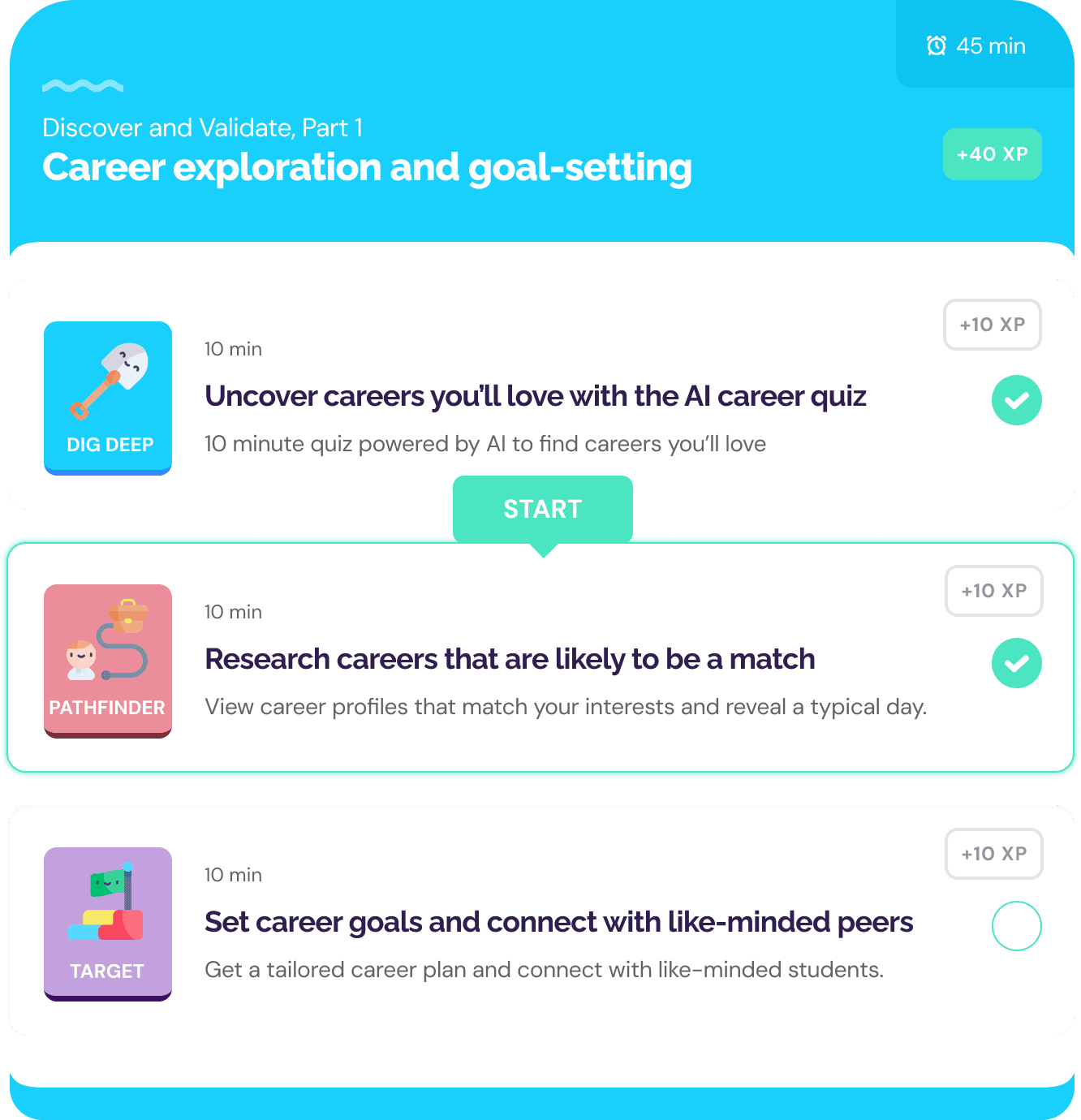
Roadmap is broken into digestible steps from discovery to offer. It is personalized based on onboarding questions around career goals, timeline, degree program, and more.
Guided, personalized roadmap from orientation to graduation


Unlike most career tools that automate away student effort, Majorly combines engaging exercises with multiple rounds of AI feedback and refinement for improved quality.
Interactive exercises combined with AI tools for ideal outcomes

Engagement is very important for Majorly’s success, so the design features many game-like elements and an exciting, motivating aesthetic to drive roadmap completion.
Gamification throughout to encourage motivation
Deep Dive: Designing the Career Roadmap
The career roadmap is the home page and spine of the product. It went through several iterations. This section covers how it evolved, what testing showed, and the results.
Early directions


Vertical cards from the start, so the layout itself implies linear progression. Broken into semesters, with students marking their own steps complete. Progress bar and goals are visible for motivation.
Semesters became year tabs, and each step grew to hold its own resources — guides, reflections, and the actual clubs we'd matched to their interests. Useful, but the page became more complicated.
Career Roadmap Sketch
Career Roadmap Version 1
Career Roadmap Version 2
Grouped steps into career development stages (e.g., explore, build experience), since a job search isn't organized by semester. Added badges and collapsible steps to keep the page short. Introduced green for completion and purple anchoring the page.
User testing two different directions
I ran moderated testing with six college students, comparing two directions for the home page: an activity-heavy version and a roadmap version. The roadmap version tested better on most dimensions, and testing surfaced several changes we carried into launch:
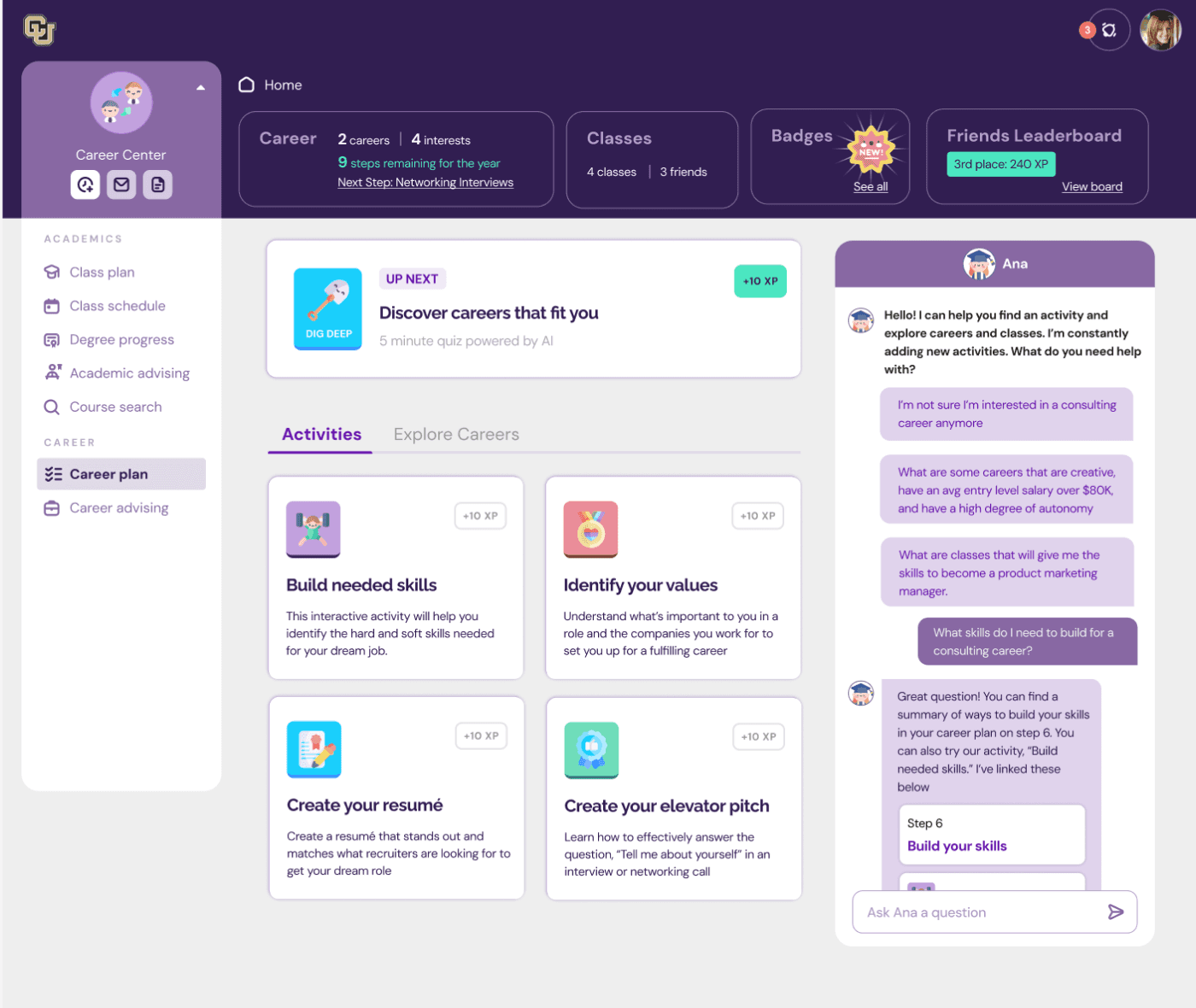
Direction 2: Activity-heavy homepage

Direction 1: Roadmap Homepage
5/6 users overestimated how long the steps would take.
All appreciated the chat, but most preferred engagement within an exercise.
Students were likely to skip marking the step as complete, and felt “do this later” made the step seem unimportant
4/6 users prioritized “urgent” tasks like the resumé, were more likely to skip key steps, and were less engaged.
6/6 users found this format more motivating. 2/6, however, felt like finishing all the steps was “a bit overwhelming”.
Final roadmap
We carried the parts of the activity-led direction that worked into the roadmap, and fixed the problems testing surfaced in the roadmap itself. This resulted in seven main changes:
Final Roadmap

One clear primary action highlighted in green with an animated start indicator, and next steps in grey, reduces the feeling of overwhelm.
Additional sections are on separate screens to reduce overwhelm, and locked to inspire progress.
Students liked the chat, so we added that on the roadmap page but demoted it to a secondary button at the top.
Students expressed loneliness in their career search and the desire to have a community with friends, so we added a friends-based leaderboard.
Students liked quick access to repeat-use tools but skipped ahead and missed steps. We moved tools to a side rail, locked until the corresponding step that introduces them is done.
Students found the full roadmap overwhelming. We broke it into color-coded subsections and set expectations in onboarding that steps don't need to be done at once: the roadmap can span a year.
Students found the full roadmap overwhelming. We broke it into color-coded subsections and set expectations in onboarding that steps don't need to be done at once: the roadmap can span a year.
Students overestimated how long steps would take, so we added time estimates.
Since students didn’t mark their activities as complete, we made progress tracking automatic.
The roadmap redesign had strong results
50% avg. completion in first 3 weeks: The roadmap drove high student engagement with Majorly. Activated students completed 50% of the roadmap on average in the first three weeks. That came out to an average of 18 minutes per day, a substantial amount of engagement for a college student to spend on their career. Engagement was an important metric for us since it’s how career advisors are evaluated.
Users reported feeling “motivated, capable, and accomplished”: Several users of Majorly in interviews told us the roadmap and product made them feel “Motivated, capable, and accomplished” as they completed it.
Designs
Marketing website
Designed to cater to both universities and students while providing a compelling experience for both.
Home page routes each customer segment to their dedicated page efficiently
Students and universities want different things, so the home page has two large cards directly below the hero, with limited content on the page so students and universities get to their dedicated page fast.
Phased progressive and interactive elements highlight the career roadmap
Through graphics, layout, and interactive elements with phased, linear structures, the website conveys the idea and benefits of the career roadmap.
Personalized career roadmap
Majorly turns years of complex career planning into one tailored, engaging path, built around each student's goals and stage.
Progressive path architecture
One active task at a time removes paralysis, and short milestones keep the path from feeling overwhelming. Green and grey completion states, locked future sections, and an animated start button encourage the user to keep working on their career.
Habit-building gamification
Badges, leaderboards, XP scaled to task effort, and animated characters keep students returning throughout the semester.
Career discovery flow
Students take an in-depth AI quiz with written and multiple choice questions to uncover their dream career. Then they explore AI-generated, citation-backed career profiles.
Career quiz designed to get depth from impatient students
Placeholder text shows what a good answer looks like, and follow-up questions branch off what the student just said. Chunking and a conversational mascot keep them going.
Career profile that informs & learns more about the student to improve suggestions
Students react to individual parts of each career. A student who reads what "navigating conflicting priorities" really means at a UX job and taps "looks challenging" allows for further personalization.
Students write their pitch with past reflections and contextual tips in the right panel. AI feedback and a revision render side by side with the draft on color-coded cards for what’s working and what to fix, enabling quick, side-by-side iteration.
Exercise: Elevator Pitch
To the left is one example of our AI-integrated, guided exercises: Elevator Pitch Creation.
Interactive exercises and elements, including learning games like matching and fill-in-the-blank, improve students’ comprehension and engagement, and were a favorite of professors who structured their Career 101 classes around Majorly.
Interactivity helps students better comprehend the material
AI-guided reflection and feedback loops
These designs enabled Majorly to achieve strong results
From 0 ➔ 30,000+ users: After launching with Quinnipiac University, we received high student engagement and satisfaction. These results helped us close four more universities, including Rutgers and the University of Maryland, and ultimately scale to more than 30,000 active users on the platform.
Students credit Majorly with landing the job: “I was stuck in a rut applying to hundreds of jobs over the years. Then I came across Majorly and the services helped me improve my resume and prepare for interviews. Within 3 months I was hired! I truly think Majorly helped me take my work experiences and communicate the impact of the results which helped me stand out on my resume and in interviews. I couldn't recommend Majorly enough” - Amanda H.
100% university retention: All universities to date have renewed their contracts.
Next Steps
Post-launch, we continued to iterate on the product, focusing first on AI quality, then on activation, and then on new features including an AI interviewer. When I left, the team was focused on adding more agentic, proactive AI throughout the product, as well as more personalization. We scaled the product from 0 to more than 30,000+ users before I left.
Reflection
Test AI features with users using live data in addition to Figma prototypes.
Focus on the context in which the product will be distributed.
When we launched we had good engagement, but we got much stronger acquisition and activation when we embedded within career classes and advising workflows at the colleges.
When we started the project, AI prototyping tools weren’t as good so we used Figma prototypes to test AI features. If I were doing this again, I would use AI prototyping tools to test the features live with users early.

